





Spring Hill sits in Hernando County where Florida's wet season dumps 50+ inches of rain annually and the water table runs exceptionally high. Homes built on the area's sandy limestone soil face constant hydrostatic pressure against foundation slabs, pushing groundwater through any crack or gap. The Weeki Wachee River watershed drains directly through Spring Hill, making flash flooding common during summer thunderstorms and tropical systems moving up the Gulf Coast.
Most Spring Hill homes were built between 1985 and 2005 during the development boom, and those aging plumbing systems now fail regularly. Polybutylene pipes installed in thousands of properties are reaching end-of-life, rupturing without warning. Add in HVAC condensate line failures from Florida's year-round cooling demands, and you have a perfect storm for water intrusion. The humidity never drops below 60 percent, even in winter, which means any moisture that enters your home starts growing mold within 24 to 48 hours. Spring Hill's combination of heavy rainfall, high water tables, aging infrastructure, and constant humidity creates water damage conditions that demand immediate professional response.
Fortress Water Damage Restoration Tampa maintains a dedicated Spring Hill response team because we understand this community faces unique challenges that generic restoration companies miss. We have studied Hernando County's soil composition, tracked local flood patterns along the Weeki Wachee watershed, and mapped the construction methods used during Spring Hill's major development phases. When we arrive at your property, we know what to expect before we walk through the door.
Our technicians hold IICRC Water Damage Restoration certification and complete annual continuing education on the latest extraction and drying science. We invested in truck-mounted extraction units that remove water five times faster than portable equipment, which matters when you are racing against mold growth in Florida's humidity. Our thermal imaging cameras detect moisture trapped inside wall cavities and under flooring that other companies miss with basic moisture meters.
We work directly with every major insurance carrier serving Spring Hill and understand exactly what documentation they require for claim approval. You will not spend hours on the phone with adjusters because we handle that communication while you focus on your family. Our project managers provide daily updates with photo documentation and moisture readings so you always know where restoration stands.
What separates Fortress from other water damage companies is our refusal to leave a job until moisture readings confirm your home is completely dry, not just surface dry. We have seen too many homeowners hire the cheapest bidder only to discover mold growth three weeks later because the company pulled equipment too early. We verify dryness with scientific measurements and back our work with written guarantees. Spring Hill deserves restoration done right the first time, and that is what we deliver on every call.

Our Spring Hill response team deploys within 60 minutes of your call, 24 hours a day, every day of the year. We arrive with truck-mounted extraction equipment ready to start water removal immediately. Fast response stops water from spreading, prevents structural damage, and keeps mold from colonizing your property. When your home floods, an hour makes the difference between minor repairs and major reconstruction.

We coordinate directly with your insurance carrier from first contact through final payment. Our documentation meets every requirement Florida insurers demand, including thermal imaging, moisture mapping, and daily photo logs. You will not fight with adjusters or chase reimbursements because we handle billing directly with your carrier. Most Spring Hill homeowners pay nothing out of pocket beyond their deductible.
Every technician responding to Spring Hill properties holds current IICRC Water Damage Restoration certification and completes annual continuing education. We follow Institute of Inspection, Cleaning and Restoration Certification standards for extraction, drying, and antimicrobial treatment. This certification is not optional training. It represents mastery of water damage science, psychrometrics, and proper drying protocols that protect your home from secondary damage.
We maintain a dedicated Spring Hill response team because Hernando County properties face water damage conditions different from Tampa or Clearwater. Our technicians understand your soil composition, know which neighborhoods flood first during heavy rain, and recognize the construction methods used in your home. Local expertise means faster diagnosis, more accurate drying plans, and better outcomes for your property.
Water damage strikes Spring Hill homes in dozens of ways, from burst supply lines and failed water heaters to roof leaks and sewer backups. Each scenario demands different equipment, techniques, and safety protocols. Fortress Water Damage Restoration Tampa responds to every category of water intrusion with specialized crews and purpose-built equipment matched to your specific emergency.
We handle Category 1 clean water events like supply line breaks and appliance failures with rapid extraction and structural drying. Category 2 gray water situations from washing machine overflows or toilet supply line failures receive antimicrobial treatment during the drying process. Category 3 black water emergencies involving sewage backups or floodwater require full containment, specialized extraction, and comprehensive disinfection to protect your family's health.
Our service range covers everything from minor bathroom floods to whole-house water removal after storm surge or catastrophic plumbing failure. We extract standing water, dry structural components, remove damaged materials, treat for microbial growth, deodorize affected areas, and coordinate reconstruction when necessary. Spring Hill homeowners receive comprehensive water damage remediation from initial emergency response through final restoration, all from one experienced team that understands Florida's unique challenges.
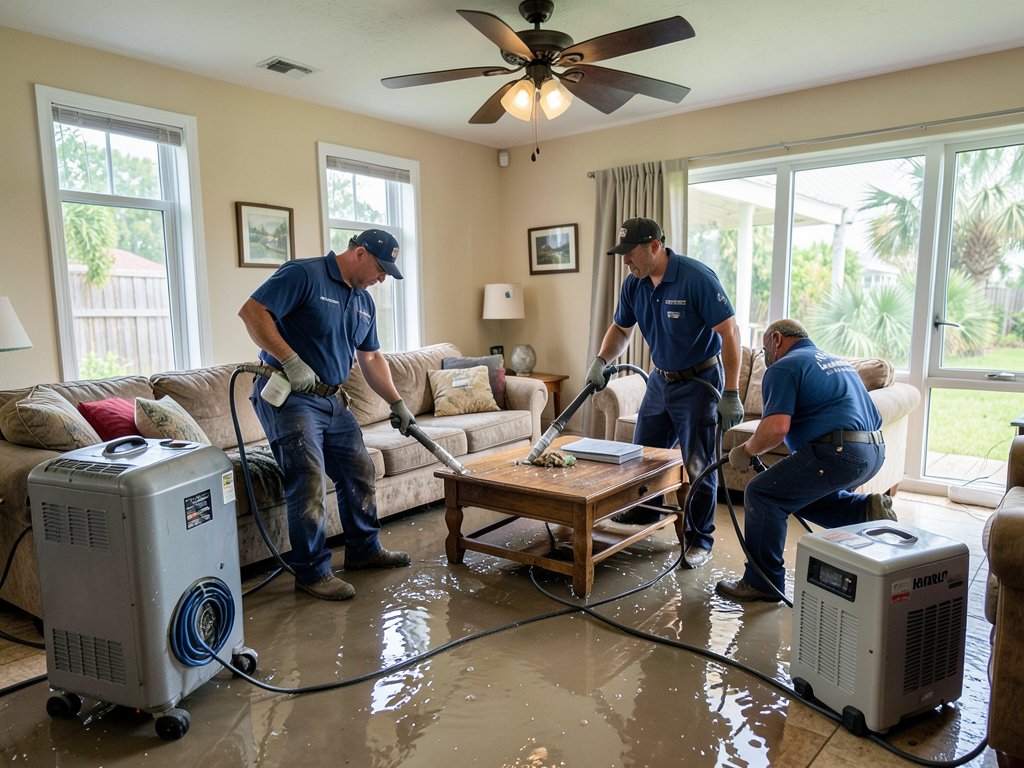
Standing water spreads through your home at alarming speed, wicking up drywall, saturating insulation, and pooling under flooring. Our truck-mounted extraction units remove thousands of gallons per hour while portable extractors pull water from tight spaces and furnishings. We extract water from carpets, pads, hardwood floors, tile, and concrete slabs using weighted wands that compress materials during extraction. Thermal imaging identifies hidden water pockets behind walls and under cabinets. Fast extraction stops water migration, reduces drying time, and prevents the secondary damage that turns a minor incident into a total loss.
Removing standing water is just the first step. Materials stay saturated for days or weeks without proper drying equipment and monitoring. We deploy industrial air movers and commercial dehumidifiers calibrated to your home's cubic footage and moisture load. Our technicians monitor temperature, humidity, and moisture content twice daily using penetrating and non-invasive meters. We adjust equipment placement based on psychrometric calculations that account for Florida's ambient humidity. Drying continues until moisture readings match unaffected areas of your home, typically seven to ten days depending on materials and saturation depth. Scientific drying prevents mold colonization and structural damage.
Sewage backups and toilet overflows introduce dangerous pathogens into your living space. Our crews respond with full personal protective equipment, establish containment barriers to prevent cross-contamination, and extract contaminated water using dedicated equipment never used for clean water events. We remove porous materials that cannot be safely disinfected, including carpet, pad, drywall, and insulation. All affected hard surfaces receive EPA-registered antimicrobial treatment. Air scrubbers with HEPA filtration remove airborne contaminants during the cleanup process. We follow strict IICRC S500 standards for Category 3 water damage to protect your family's health and safety.
Spring Hill's combination of aging housing stock, extreme weather, and high humidity creates water damage conditions that catch homeowners off guard. Properties built during the 1990s development boom now face simultaneous system failures as plumbing, roofing, and HVAC components reach end-of-life. Florida's wet season brings daily thunderstorms that overwhelm gutters and test roof integrity. The area's high water table means groundwater constantly pushes against foundation slabs, finding any weakness.
Understanding these common failure points helps Spring Hill residents recognize warning signs before minor moisture becomes major damage. Water stains, musty odors, and visible mold growth indicate active intrusion that demands immediate professional attention. These issues do not resolve themselves. They worsen daily in Florida's humidity until you address the source and properly dry affected materials.
Thousands of Spring Hill homes built between 1985 and 1995 contain polybutylene supply pipes that are now failing catastrophically. These gray plastic pipes deteriorate from chlorine exposure and burst without warning, flooding homes with hundreds of gallons. If your home has polybutylene plumbing, replacement is not optional. It is required to prevent sudden failure and total loss.
Spring Hill receives intense thunderstorms daily from June through September, with wind-driven rain testing every roof penetration and flashing detail. Aging shingles lose granules and crack, allowing water into attic spaces where it saturates insulation and drips into living areas. Many homeowners discover roof leaks only after ceilings stain or drywall crumbles from hidden moisture.
Air conditioning systems in Spring Hill run nearly year-round, generating gallons of condensate daily. When drain lines clog from algae growth or disconnect from vibration, water overflows into attic spaces or floods from ceiling-mounted air handlers. These failures happen gradually, creating hidden moisture problems that grow mold before homeowners notice water damage. Regular HVAC maintenance prevents most condensate failures.
Spring Hill's high water table creates constant hydrostatic pressure against foundation slabs. Any crack or gap allows groundwater to seep through, wetting flooring and carpets from below. This moisture source puzzles homeowners because no pipe leak or roof failure explains the dampness. Slab seepage requires exterior drainage solutions and waterproofing, not just drying the interior.
Water damage emergencies create chaos and panic. Your home is flooding. Possessions are getting ruined. You need help fast but do not know who to trust or what happens next. Fortress Water Damage Restoration Tampa brings order to crisis with clear communication, rapid deployment, and transparent processes from first contact through project completion.
When you call our Spring Hill response line, a live person answers immediately, 24 hours a day. We do not use answering services or route calls to distant offices. You speak directly with someone who understands water damage and can dispatch help within minutes. Our intake specialists gather essential information about your emergency, alert your insurance carrier if you request, and give you a realistic timeframe for crew arrival. No vague promises. No confusion about next steps. Just clear guidance when you need it most.
Our Spring Hill crew arrives within 60 minutes with full extraction equipment and assessment tools. The crew chief introduces the team, explains the inspection process, and then documents your property's condition with photos, thermal imaging, and moisture readings. You receive a written scope of work detailing what we will do, what equipment we will use, and how long drying typically takes for your situation. No surprise charges. No hidden fees. Just honest assessment of what your home needs to prevent secondary damage.
Water damage restoration takes days, not hours. We visit your property daily to check equipment, take moisture readings, and adjust drying strategy based on real data. Your project manager sends text or email updates with current moisture levels and photos showing progress. You always know what is happening and how much longer equipment needs to run. We never pull equipment based on schedules or guesswork. Drying continues until moisture meters confirm your home matches pre-loss readings.
Florida insurance carriers demand specific documentation for water damage claims. We provide everything required including thermal imaging, moisture mapping logs, equipment placement photos, daily monitoring reports, and itemized scope of work. Our project managers communicate directly with adjusters to answer questions and provide additional documentation when needed. Most Spring Hill homeowners receive full claim approval because we deliver the proof insurance companies require. You focus on your family while we handle the paperwork.
We structured our restoration process around one goal: return your home to pre-loss condition as quickly as possible while preventing secondary damage. Every step follows IICRC standards and focuses on your needs.
Call our 24-hour Spring Hill response line at (656) 219-8088 the moment you discover water damage. Our intake specialist gathers essential information about your emergency, alerts your insurance carrier if requested, and dispatches the nearest crew to your property. Our goal is arrival within 60 minutes, day or night, weekday or holiday. While the crew travels, we provide immediate guidance on safety steps like shutting off water sources or electricity if needed.
Our crew begins with complete documentation using photos, thermal imaging, and moisture readings to establish baseline conditions. We extract all standing water using truck-mounted units and portable extractors, then deploy industrial air movers and commercial dehumidifiers calibrated to your home's moisture load. The crew chief explains equipment placement, expected drying timeline, and monitoring schedule. We remove damaged materials that cannot be saved and protect salvageable contents from further exposure.
Our technicians visit daily to check equipment function, document moisture levels, and adjust drying strategy based on readings. We provide regular updates on progress and timeline adjustments if needed. Equipment runs until moisture meters confirm your home is completely dry, typically seven to ten days. Final documentation includes completion photos, final moisture readings, and antimicrobial treatment certification. We coordinate reconstruction if needed or release the property back to you completely dry and ready for use.
Water damage restoration is not just extraction and fans. It is applied building science using psychrometrics, vapor pressure, and material-specific drying principles to remove moisture before microbial growth begins. Florida's climate complicates restoration because ambient humidity never drops below 60 percent, even in winter. Drying materials in this environment requires understanding how temperature, relative humidity, and air movement interact to create the vapor pressure differential needed for evaporation.
IICRC S500 Standard and Reference Guide for Professional Water Damage Restoration establishes the protocols we follow on every Spring Hill project. This document represents decades of restoration science and defines proper techniques for water classification, material handling, and drying verification. We categorize water damage as Category 1 (clean), Category 2 (gray), or Category 3 (black) based on contamination level, which determines safety protocols and salvageability of materials. We also classify projects by evaporation speed as Class 1 through Class 4, with Class 4 specialty drying situations requiring advanced techniques like controlled demolition or injection drying systems.
Our moisture monitoring follows specific psychrometric principles. We measure temperature and relative humidity in affected areas, then calculate grains per pound (GPP) and dew point to determine atmospheric moisture load. As materials dry and release moisture into the air, dehumidifiers remove that moisture while air movers accelerate evaporation. We adjust equipment daily based on changing conditions. Penetrating moisture meters measure moisture content in wood and drywall as a percentage, while non-invasive meters scan large areas quickly to identify hidden pockets.
Florida Administrative Code 61-31 establishes mold remediation standards that intersect with water damage restoration. Any material wetted by Category 2 or 3 water for more than 48 hours is presumed to contain mold growth and must be handled accordingly. This is why rapid response matters. The faster we extract water and begin drying, the more materials we can save and the less demolition your home requires.
Our thermal imaging cameras detect moisture problems invisible to the eye. Water wicks up drywall, travels through wall cavities, and saturates insulation without leaving surface evidence. Thermal imaging reveals temperature differences caused by evaporative cooling wherever moisture remains. This technology guides our extraction efforts and confirms complete drying before we remove equipment. Spring Hill homeowners deserve restoration guided by science, not guesswork, and that is exactly what our IICRC-certified technicians deliver on every project.
The Institute of Inspection, Cleaning and Restoration Certification publishes the S500 Standard, which establishes proper water damage restoration procedures. This document defines water and drying classifications, material handling protocols, and documentation requirements. Every Fortress project follows S500 standards to ensure your home receives scientifically sound restoration that prevents secondary damage. Insurance carriers recognize IICRC compliance as proof of proper restoration methodology.
We classify water damage by contamination level (Category 1, 2, or 3) and evaporation challenge (Class 1 through 4). Category determines safety protocols and whether materials can be salvaged. Class determines equipment needs and drying timeline. A Class 4 hardwood floor flood requires different techniques than a Class 1 bathroom overflow. Proper classification ensures your home receives appropriate restoration matched to actual conditions.
Drying materials requires creating a vapor pressure differential between wet materials and surrounding air. We measure temperature, relative humidity, and grains per pound to calculate atmospheric moisture load, then use dehumidifiers to remove moisture released by evaporation. Air movers accelerate this process by increasing air circulation across wet surfaces. Daily monitoring ensures equipment runs at optimal settings. Materials dry when moisture content matches unaffected areas, verified with calibrated meters.
Florida Administrative Code 61-31 presumes mold growth on any material wetted by contaminated water for more than 48 hours. This drives our rapid response commitment. The faster we extract water and begin drying, the more materials we save and the less your home requires demolition. Any material showing visible mold receives proper remediation including containment, removal, and disposal following state guidelines. Our goal is always preventing mold through fast response and thorough drying.
This video explains professional water damage restoration services for Spring Hill, Florida homeowners. Learn about emergency water extraction, structural drying techniques, insurance claim coordination, and why rapid response prevents mold growth in Florida's humid climate. Covers common water damage sources in Hernando County including plumbing failures, roof leaks, HVAC issues, and groundwater seepage. Features information on IICRC restoration standards, thermal imaging moisture detection, and proper drying protocols for Florida homes.
Fortress Water Damage Restoration Tampa maintains dedicated response capability throughout Spring Hill and surrounding Hernando County communities because we recognize this region faces unique water damage challenges. Our crews know the area intimately, from the original Spring Hill development along Mariner Boulevard to the newer construction spreading east toward the Suncoast Parkway. We respond daily to properties in Hernando Beach where coastal proximity and older construction create constant moisture issues, and to homes in the Timber Pines community where aging infrastructure demands vigilant maintenance.
The neighborhoods west of US Highway 19 include some of Spring Hill's oldest residential areas, with homes built in the 1970s and 1980s now experiencing simultaneous plumbing, roofing, and foundation failures. These properties often contain outdated materials like polybutylene pipes and original HVAC systems that fail catastrophically. We have restored hundreds of homes in this corridor and understand the construction methods used during that era. East of the Suncoast Parkway, newer developments in areas like Silverthorn and Hammock Oaks feature modern building codes and materials, but these homes still face Florida's humidity, severe weather, and water table challenges.
Our response area extends north into Weeki Wachee where properties near the Weeki Wachee River face seasonal flooding and elevated water tables. We serve Brooksville to the north and cover the entire Hernando County coastal region where salt air accelerates material deterioration and tropical systems bring storm surge. The commercial corridor along Commercial Way and the residential streets surrounding Nature Coast Technical High School represent our daily service territory.
Spring Hill's position along Florida's Nature Coast means water damage can strike from multiple directions simultaneously. Summer thunderstorms drop inches of rain in minutes, overwhelming drainage systems. Tropical systems moving up the Gulf Coast push storm surge into low-lying areas while dumping heavy rainfall inland. The Weeki Wachee watershed drains directly through Spring Hill, making flash flooding common during extreme weather. Our local presence and geographic expertise mean faster response times and better outcomes for property owners throughout Hernando County. We understand your neighborhood, know your risks, and stand ready to respond when water damage strikes.
Water damage restoration costs in Spring Hill vary based on the damage extent, water category, and affected square footage. A small leak might run a few hundred dollars, while major flooding or storm damage costs significantly more. Class 1 damage (minimal absorption) costs less than Class 4 (deep saturation into hardwoods or stone). Hurricane-prone Spring Hill homes often face higher costs due to category 3 water contamination. Most companies offer free inspections and work directly with your insurance adjuster to determine covered expenses. Always get a detailed estimate before work begins.
Yes. Water damage restoration prevents structural deterioration, mold growth, and health hazards that worsen over time. Spring Hill's high humidity accelerates microbial growth within 24 to 48 hours, turning a manageable problem into a health crisis. Ignoring water damage drops your property value and creates liability issues if you sell later. Professional restoration protects your investment, maintains indoor air quality, and prevents wood rot in your floor joists and wall studs. The cost of restoration now beats the cost of demolition and reconstruction later.
It depends on the severity. Minor water damage from a supply line leak might cost less than repainting a room. Major damage from storm surge or sewer backup gets expensive fast because it requires structural drying, antimicrobial treatment, and material replacement. Spring Hill's coastal proximity means salt-laden floodwater corrodes faster, increasing repair complexity. Category 3 black water demands full sanitization and disposal protocols. Insurance often covers sudden and accidental damage, reducing your out-of-pocket expense. Get multiple quotes and verify the scope of work before committing.
Water damage restoration costs in Spring Hill vary based on the damage extent, water category, and affected square footage. A small leak might run a few hundred dollars, while major flooding or storm damage costs significantly more. Class 1 damage (minimal absorption) costs less than Class 4 (deep saturation into hardwoods or stone). Hurricane-prone Spring Hill homes often face higher costs due to category 3 water contamination. Most companies offer free inspections and work directly with your insurance adjuster to determine covered expenses. Always get a detailed estimate before work begins.
Yes. Water damage restoration prevents structural deterioration, mold growth, and health hazards that worsen over time. Spring Hill's high humidity accelerates microbial growth within 24 to 48 hours, turning a manageable problem into a health crisis. Ignoring water damage drops your property value and creates liability issues if you sell later. Professional restoration protects your investment, maintains indoor air quality, and prevents wood rot in your floor joists and wall studs. The cost of restoration now beats the cost of demolition and reconstruction later.
It depends on the severity. Minor water damage from a supply line leak might cost less than repainting a room. Major damage from storm surge or sewer backup gets expensive fast because it requires structural drying, antimicrobial treatment, and material replacement. Spring Hill's coastal proximity means salt-laden floodwater corrodes faster, increasing repair complexity. Category 3 black water demands full sanitization and disposal protocols. Insurance often covers sudden and accidental damage, reducing your out-of-pocket expense. Get multiple quotes and verify the scope of work before committing.
Most homeowners policies cover sudden and accidental water damage, like burst pipes or appliance malfunctions. Spring Hill residents should verify hurricane and flood coverage separately, as standard policies exclude rising water and storm surge. Gradual damage from neglected maintenance gets denied. Your restoration company should document everything with photos and moisture readings to support your claim. Most reputable contractors in Spring Hill work directly with insurance adjusters and handle the paperwork. Review your policy exclusions and deductibles before filing to understand your financial responsibility.
Response times vary by company availability and job complexity. Most restoration companies in Spring Hill, including national franchises, aim for same-day emergency response. Actual drying takes three to five days for standard residential jobs, longer for commercial properties or severe saturation. Spring Hill's humidity extends drying times compared to drier climates. The timeline includes water extraction, dehumidification, antimicrobial treatment, and verification with moisture meters. Ask any company for a projected timeline during the initial assessment. Faster is not always better if proper drying protocols get skipped.
The average water damage claim in Florida ranges from $7,000 to $12,000, but Spring Hill claims vary widely based on damage type. A supply line leak averages lower, while hurricane-related flooding pushes claims higher. Category 3 contamination and structural damage increase totals. Your claim amount depends on your coverage limits, deductible, and whether the adjuster approves all line items. Document everything immediately with photos and videos. Many Spring Hill homeowners underestimate secondary damage like mold or floor buckling, which inflates final costs if discovered later during restoration.
Call immediately when you discover standing water, visible saturation, or water actively leaking. Spring Hill's climate makes the first 24 hours critical before mold spores colonize. Also call if you smell musty odors, notice ceiling stains, or see warped flooring. After a hurricane or severe storm, call even if damage seems minor. Hidden moisture inside walls and subfloors worsens daily. Do not wait to see if it dries on its own. Professional moisture detection finds problems you cannot see, preventing future structural failure and health hazards.
Mold can return if moisture sources are not eliminated or if remediation was incomplete. Spring Hill's year-round humidity feeds mold growth, so proper dehumidification and ventilation are essential post-remediation. If the original water intrusion point was not fixed, like a roof leak or plumbing issue, mold returns quickly. Poor attic ventilation and crawl space moisture create recurring problems. Quality remediation includes source repair, antimicrobial treatment, and moisture control strategies. Always verify the contractor addressed the root cause, not just surface mold, to prevent recurrence.
Water damage restoration requires specialized equipment, skilled labor, and strict protocols. Thermal imaging cameras, industrial dehumidifiers, air movers, and moisture meters cost thousands. Spring Hill's humidity demands longer drying cycles and more equipment runtime, increasing electricity and labor costs. Category 3 contamination requires hazmat disposal and EPA-compliant sanitization. Structural drying prevents secondary damage that costs far more to repair later. Insurance fraud forces legitimate companies to document every step thoroughly, adding administrative expense. You pay for expertise that prevents mold, structural collapse, and health hazards down the road.
Insurance pays for sudden and accidental water damage, not gradual wear or maintenance neglect. Spring Hill homeowners must prove the damage was unexpected, like a burst pipe or appliance failure. Flood insurance is separate and required for rising water coverage. Your adjuster reviews your policy exclusions, deductible, and coverage limits before approving payment. Documentation is critical. Take photos immediately, keep damaged materials for inspection, and get a professional assessment. Most claims get approved if you file promptly and provide thorough evidence of sudden, covered damage.
Most homeowners policies cover sudden and accidental water damage, like burst pipes or appliance malfunctions. Spring Hill residents should verify hurricane and flood coverage separately, as standard policies exclude rising water and storm surge. Gradual damage from neglected maintenance gets denied. Your restoration company should document everything with photos and moisture readings to support your claim. Most reputable contractors in Spring Hill work directly with insurance adjusters and handle the paperwork. Review your policy exclusions and deductibles before filing to understand your financial responsibility.
Response times vary by company availability and job complexity. Most restoration companies in Spring Hill, including national franchises, aim for same-day emergency response. Actual drying takes three to five days for standard residential jobs, longer for commercial properties or severe saturation. Spring Hill's humidity extends drying times compared to drier climates. The timeline includes water extraction, dehumidification, antimicrobial treatment, and verification with moisture meters. Ask any company for a projected timeline during the initial assessment. Faster is not always better if proper drying protocols get skipped.
The average water damage claim in Florida ranges from $7,000 to $12,000, but Spring Hill claims vary widely based on damage type. A supply line leak averages lower, while hurricane-related flooding pushes claims higher. Category 3 contamination and structural damage increase totals. Your claim amount depends on your coverage limits, deductible, and whether the adjuster approves all line items. Document everything immediately with photos and videos. Many Spring Hill homeowners underestimate secondary damage like mold or floor buckling, which inflates final costs if discovered later during restoration.
Call immediately when you discover standing water, visible saturation, or water actively leaking. Spring Hill's climate makes the first 24 hours critical before mold spores colonize. Also call if you smell musty odors, notice ceiling stains, or see warped flooring. After a hurricane or severe storm, call even if damage seems minor. Hidden moisture inside walls and subfloors worsens daily. Do not wait to see if it dries on its own. Professional moisture detection finds problems you cannot see, preventing future structural failure and health hazards.
Mold can return if moisture sources are not eliminated or if remediation was incomplete. Spring Hill's year-round humidity feeds mold growth, so proper dehumidification and ventilation are essential post-remediation. If the original water intrusion point was not fixed, like a roof leak or plumbing issue, mold returns quickly. Poor attic ventilation and crawl space moisture create recurring problems. Quality remediation includes source repair, antimicrobial treatment, and moisture control strategies. Always verify the contractor addressed the root cause, not just surface mold, to prevent recurrence.
Water damage restoration requires specialized equipment, skilled labor, and strict protocols. Thermal imaging cameras, industrial dehumidifiers, air movers, and moisture meters cost thousands. Spring Hill's humidity demands longer drying cycles and more equipment runtime, increasing electricity and labor costs. Category 3 contamination requires hazmat disposal and EPA-compliant sanitization. Structural drying prevents secondary damage that costs far more to repair later. Insurance fraud forces legitimate companies to document every step thoroughly, adding administrative expense. You pay for expertise that prevents mold, structural collapse, and health hazards down the road.
Insurance pays for sudden and accidental water damage, not gradual wear or maintenance neglect. Spring Hill homeowners must prove the damage was unexpected, like a burst pipe or appliance failure. Flood insurance is separate and required for rising water coverage. Your adjuster reviews your policy exclusions, deductible, and coverage limits before approving payment. Documentation is critical. Take photos immediately, keep damaged materials for inspection, and get a professional assessment. Most claims get approved if you file promptly and provide thorough evidence of sudden, covered damage.
We proudly serve the entire Tampa area with rapid-response water damage restoration services. Whether you’re downtown, in the suburbs, or operating a business near the bay, our expert team is just minutes away. Use the map below to view our service zone or find our nearest location. We’re ready to respond wherever you need us. Your peace of mind is only a call or click away.
Address:
Spring Hill, FL, 34609

The Home Buyer Guide to Spotting Hidden Water Damage During a Westchase Open House Walking through an open house in Westchase should feel exciting. You imagine your family in the kitchen. You picture weekend barbecues…
How Clogged Gutters and Downspouts Can Lead to a Flooded Living Room in Wooded Lutz…

Why You Should Never Use Bleach to Clean Up Mold After a Leak in Your…

Dealing With Water Damage in Your Backyard ADU or Guest House in Seminole Heights Water…
Water damage worsens every minute. Call Fortress Water Damage Restoration Tampa now at (656) 219-8088 for 60-minute emergency response anywhere in Spring Hill. Our crews are standing by 24 hours a day with full extraction and drying equipment. Stop the damage now before it destroys your home.